What Is Jitter on Oscillator? Why Is It so Important for Electr
-
Understanding Jitter in High-Precision Crystal Oscillators
crystal oscillator jitter is a critical parameter in high-precision crystal oscillators, as it measures the deviation in the timing of a clock signal from its ideal periodicity. It is typically expressed in picoseconds (ps) or femtoseconds (fs), where lower values indicate better timing precision. Jitter directly impacts the performance, reliability, and functionality of electronic systems, especially in high-speed and precision applications.
Importance of Low Jitter in High-Precision Crystal Oscillator
Oscillator Stability:
low jitter oscillator ensures the stability of the oscillator in the time domain.
In applications like communication systems, data converters, and high-speed digital systems, precise timing is essential for accurate data sampling and signal processing.
A stable oscillator minimizes timing errors, ensuring consistent system performance.
Data Integrity:
In systems where data is synchronized to a clock signal, excessive jitter can cause timing errors, leading to data corruption or loss.
For example, in high-speed serial communication (e.g., PCIe, Ethernet), low jitter is critical to maintain error-free data transmission.
Spectral Purity:
Jitter contributes to phase noise, which is the frequency-domain representation of timing instability.
Poor phase noise degrades the spectral purity of the clock signal, which is especially problematic in RF and wireless communication systems.
Low jitter ensures clean signals, improving the performance of systems like radios, cellular networks, and satellite communications.
Analog-to-Digital Converters (ADCs) and Digital-to-Analog Converters (DACs):
In precision applications such as audio processing, instrumentation, or medical imaging, low jitter is crucial for maintaining the accuracy of ADCs and DACs.
Jitter introduces sampling errors in ADCs, which can degrade the quality of the digitized signal.
Similarly, in DACs, jitter can affect the reconstruction of analog signals, leading to distortion or noise.
Oscillator Distribution and Synchronization:
In systems with multiple components or integrated circuits, a low-jitter oscillator ensures accurate synchronization across the system.
Excessive jitter can cause timing skew, where different parts of the system operate out of sync, leading to performance degradation or system failure.
Example: Jitter Performance of XtalTQ VCXO
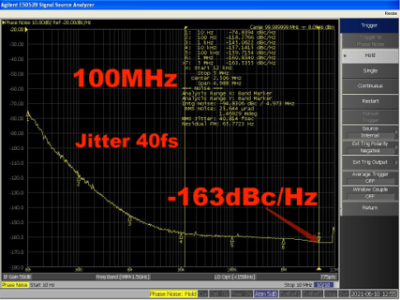
XtalTQ VCXO 100 MHz: Jitter = 40 fs
XtalTQ VCXO 122.88 MHz: Jitter = 31 fs
These values represent extremely low jitter, making these oscillators ideal for high-precision applications. For context:
40 fs (femtoseconds) is 0.00000000004 seconds, and 31 fs is even smaller.
Such low jitter ensures exceptional timing precision, stability, and spectral purity, which are critical for applications like 5G networks, high-speed data converters, and RF systems.
Minimizing Jitter in System Design
To achieve low jitter in a system, designers focus on:
Component Selection:
Use high-quality, low-jitter crystal oscillators or voltage-controlled crystal oscillators (VCXOs).
Select components with low phase noise and high stability.
PCB Layout Considerations:
Minimize noise and interference by using proper grounding, shielding, and trace routing techniques.
Avoid crosstalk and power supply noise, which can increase jitter.
Clock Distribution:
Use low-jitter clock buffers and distribution networks to maintain signal integrity across the system.
Power Supply Design:
Ensure a clean and stable power supply to the oscillator to avoid introducing noise that can increase jitter.
Conclusion
Low jitter is a critical requirement for high-precision crystal oscillators, as it directly impacts system performance, data integrity, and spectral purity. The XtalTQ VCXO oscillators with jitter values of 40 fs and 31 fs are excellent examples of high-performance clock sources suitable for demanding applications like communication systems, ADCs/DACs, and RF systems. By minimizing jitter, designers can ensure reliable, high-quality performance in modern electronic systems.