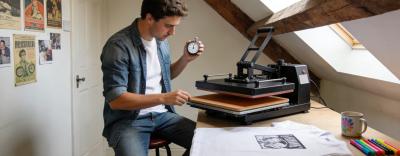
A few years ago, setting up a small T-shirt printing setup at home in the UK would have sounded like something only serious makers or niche hobbyists would do. Today, it’s become surprisingly normal. Walk into any local craft fair, Etsy shop, or even an Instagram small business page, and chances are you’ll see products that started on a kitchen table or in a spare room.
What’s changed is not just the equipment, but the mindset. People are no longer waiting to “start a business properly.” They’re testing ideas at home first. T-shirts, hoodies, tote bags, even mugs and caps. It’s all part of the same shift toward small, flexible, low-risk creative income streams.
But once you actually start looking into it, the reality is very different from what social media shows. It’s not just “buy a machine and print designs.” The setup, workflow, space, and even electricity usage all matter more than most beginners expect.
This is where most people either get overwhelmed or buy the wrong equipment.
So instead of theory, let’s go through what actually matters when setting up a heat press T-shirt printing space at home in the UK.
There are a few real reasons this trend has taken off, and they’re not just about creativity.
First, people are looking for flexible side income. Not necessarily to replace a job, but to build something on the side that can grow over time. T-shirt printing fits this perfectly because you can start small and scale gradually.
Second, the UK market is very event-driven. Think about how many occasions people buy custom apparel for:
These are not one-time trends. They happen all year round.
Finally, equipment has become much more accessible. Heat presses that used to cost serious money are now within reach for beginners, and materials like sublimation blanks and vinyl are easy to order online.
But the real question is not why people start. It’s why many struggle after the first few months.
And the answer usually comes down to setup decisions made too quickly.
If there is one piece of equipment that determines your success more than anything else, it is the heat press.
Not your printer. Not your designs. Not even your materials.
The heat press controls consistency, and consistency is what makes your prints look professional instead of random.
For home use in the UK, there are generally three practical directions people go in.
Clamshell presses are the most common starting point. They are compact, easy to understand, and fit well in small rooms. For someone working in a spare bedroom or shared space, this design makes sense because it does not require much movement space.
Swing-away presses feel more industrial. They take up more space, but they offer better control over pressure and alignment. If you plan to print thicker garments or want more accuracy, this style is often preferred once you move beyond the beginner stage.
Multi-function presses look attractive at first because they promise versatility. In reality, many home users end up using only the flat platen most of the time. The attachments sound useful, but they can slow down the workflow if you are trying to print efficiently.
The biggest mistake is overestimating what you need at the start. Most home users in the UK never go beyond T-shirts and basic apparel in the first year. That alone should guide your decision.
One of the most underestimated decisions is heat press size.
Many beginners assume bigger is better. In reality, space in a UK home setup is often limited, and a larger machine does not automatically improve results.
For most home-based T-shirt printing, a mid-sized platen is the most practical option. It gives enough surface area for standard adult prints without overwhelming your workspace.
Smaller presses can feel restrictive because you often need to reposition garments, which affects consistency and increases the chance of misalignment. On the other hand, oversized industrial machines are rarely necessary unless you are running batch production daily.
What most experienced home users eventually realise is simple. A balanced size that fits your room matters more than maximum capacity.
A lot of beginners imagine they need a garage or dedicated studio. That is not true for most home setups.
A typical UK spare room or even a well-organised corner can be enough.
What you actually need is:
A small setup can realistically fit in a room as small as a typical home office. The key is organisation, not size.
You do not need a large production environment. You need a clean, controlled working surface.
One thing people rarely calculate is electricity usage.
A standard home heat press typically uses between 1.5kW and 2kW when heating. It does not run at full power all the time, but during warm-up and pressing cycles, it can draw noticeable energy.
In practical UK terms, running a heat press for a few hours a day will increase your electricity bill, but not dramatically if used moderately. Most small home users report it being similar to running a kettle intermittently throughout the day rather than a continuous high-load appliance.
Where costs increase is not electricity alone, but inefficiency. Wasted materials, failed prints, and incorrect settings end up costing more than power usage.
That is why learning proper technique early matters more than trying to optimise energy consumption.
The biggest frustration in home T-shirt printing is inconsistency.
One print looks perfect. The next one looks faded or uneven. This usually has nothing to do with equipment quality and everything to do with process.
The most common issues are:
In the UK market, where customers expect Etsy-level finish even from small sellers, these details matter a lot.
The difference between amateur and professional results is rarely equipment. It is repetition and discipline.
Most people underestimate the learning curve.
The first few weeks are usually experimental. You will waste materials. You will get uneven prints. That is normal.
After a month or two of consistent practice, most users start to understand their machine properly. But real consistency usually comes after repeated cycles of:
This is why many successful home businesses start slowly. They treat the first phase as learning, not production.
Yes, and in most cases, that is exactly how it works.
A single person can handle:
The workflow is manageable as long as the order volume is realistic.
Where it becomes difficult is when people try to scale too quickly without adjusting their setup. At higher volumes, time management becomes the real challenge, not technical ability.
A heat press is not a “set and forget” machine.
Basic maintenance makes a noticeable difference in performance over time.
Keeping the platen clean prevents residue buildup that can affect prints. Checking pressure regularly avoids uneven transfers. Storing the machine properly reduces wear and tear.
These are small habits, but they extend the lifespan of your equipment significantly.
A realistic home T-shirt printing setup in the UK does not need to be complicated.
Most people end up with:
What matters most is not the number of tools, but how smoothly everything fits together.
When the workflow is simple, production becomes repeatable. And repeatability is what turns a hobby into something sustainable.
Instead of thinking about building a “business setup,” it helps to think in stages.
Start by learning how your materials behave. Focus on getting consistent prints before worrying about scaling or branding. Once that becomes natural, then expansion makes sense.
In the UK market right now, the most successful small home printers are not the ones with the most expensive equipment. They are the ones who understand their process well enough to avoid waste and maintain quality.
Home T-shirt printing is not difficult, but it does require patience and attention to detail. Once those foundations are in place, everything else becomes much easier to manage.
