Categories
Tags
-
#uk
#Small Business
#Sublimation Transfer Printing suppliers
#how to
#Ceramic Mugs
##Custom printing
#t-shirt printing
##Printing
#DOORMAT
#diy
#Dye Sublimation Paper
#Custom T-Shirts
#sublimation
#UK sellers
##leather
#Heat Transfer Vinyls
##SmallBusiness
##PolymerProduction
#heat press
#Mugs and Cups
#vinyl
#Heat Transfer
#clam heat press
#heat press 15x15
#EtsySeller
#sublimation blanks
#hustle
#Heat Press Machine
#Sublimation Printing
#Automatic
#How to remove HTV
#print tips
#cutter plotter
#HTV
Archives
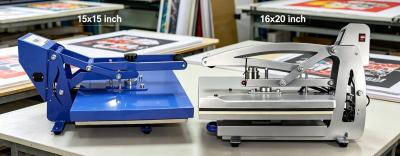
15×15 vs 16×20 Heat Press: Which Size Makes More Sense for You
-
Posted by Edi Jiang Filed in Business #Dye Sublimation Paper #heat press 15x15 #Heat Press Machine #Sublimation Printing 57 views
One of the most common mistakes people make when buying their first heat press machine has nothing to do with temperature settings, pressure systems, or even machine quality.
It comes down to size.
At first glance, the difference between a 15×15 heat press and a 16×20 heat press seems almost insignificant. A single inch wider and a few inches longer hardly sounds like something worth stressing over.
Yet after years of seeing hobbyists, Etsy sellers, apparel startups, and print shop owners build their businesses, it is often this decision that determines whether someone feels satisfied with their purchase six months later.
Some people buy too small and outgrow their machine almost immediately.
Others spend extra money on a larger press only to discover they rarely use the additional space.
So how do you know which size actually fits your needs?
The answer has less to do with the machine itself and more to do with the type of work you plan to produce.
Why Heat Press Size Matters More Than Most Beginners Expect
When people compare heat presses, they naturally focus on features.
Digital controller.
Swing-away or clamshell design.
Automatic opening.
Pressure adjustment.
All of those things matter.
But the platen size affects every single job you complete.
Unlike upgrading software or adding accessories later, the pressing area is fixed from the moment you buy the machine.
If the design you want to print does not comfortably fit inside the platen area, there is no shortcut.
You either reposition the transfer and press multiple times or upgrade to a larger machine.
That is why experienced print operators often consider platen size before almost anything else.
What Most Small Businesses Actually Print
Before choosing a machine, it helps to look honestly at what generates revenue for most new businesses.
The reality is that many startup apparel brands and side-hustle sellers are not producing oversized fashion graphics on day one.
Most begin with:
- Standard front-chest T-shirt prints
- Small logo placements
- Tote bags
- Baby clothing
- Cushion covers
- Mouse pads
- Basic promotional products
For this kind of work, a 15×15 heat press handles the job comfortably.
In fact, many successful home-based printing businesses operate for years without feeling limited by a machine of this size.
The reason is simple.
Most everyday designs are smaller than people imagine.
A logo on the left chest of a polo shirt occupies very little space.
A standard front graphic on an adult T-shirt often leaves plenty of room around the transfer when using a 15×15 press.
For many users, the machine feels larger than expected once they begin working with real products rather than theoretical measurements.
The Moment a 15×15 Heat Press Starts Feeling Small
There is a particular stage where business owners begin noticing the limitations of a smaller platen.
Usually, it happens when product offerings expand.
Maybe customers start requesting larger graphics.
Perhaps hoodies become a significant part of the product range.
Or maybe the business begins producing fashion-oriented designs where oversized prints are part of the aesthetic.
This is where available pressing space suddenly becomes valuable.
Larger transfers are not necessarily impossible on a 15×15 machine.
The challenge is efficiency.
A job that requires one press cycle on a larger machine may require repositioning on a smaller one.
That adds time.
More importantly, it introduces additional opportunities for alignment mistakes.
Anyone who has accidentally shifted a transfer by a few millimetres understands how frustrating that can be.
Why Many Experienced Sellers Prefer 16×20
People often assume larger heat presses exist mainly for commercial print shops.
That is not entirely true.
One of the biggest advantages of a 16×20 heat press has nothing to do with production volume.
It is convenience.
The extra surface area gives operators more room to work.
Garments can be positioned more comfortably.
Large transfers fit without feeling cramped.
Alignment tends to be easier because there is additional space around the design.
When pressing hoodies, sweatshirts, and oversized T-shirts, that breathing room can make the workflow noticeably smoother.
Many users who upgrade to a larger machine say the biggest difference is not what they can print.
It is how much less stressful the printing process feels.
Thinking Beyond T-Shirts
A surprising number of people purchase heat presses assuming they will only print apparel.
Then six months later they discover entirely new product categories.
This happens constantly.
Someone starts with T-shirts.
Then they add tote bags.
Next come decorative panels, pillow covers, promotional products, and personalised gifts.
As product variety increases, flexibility becomes more important than maximum output.
A 16×20 heat press offers greater versatility simply because it accommodates a wider range of blank products.
That does not automatically make it the better choice.
But it does explain why growing businesses often gravitate toward larger machines over time.
The Workspace Question Nobody Talks About
Machine dimensions affect more than production capability.
They affect your daily working environment.
A compact 15×15 heat press fits comfortably into many home workshops, spare bedrooms, garages, and small business spaces.
A larger 16×20 machine naturally demands more room.
That may not sound important while browsing product listings.
It becomes very important when the machine arrives.
Remember that a heat press needs operating space, not just storage space.
You need room to open it safely.
You need room to position garments.
You need room to move around comfortably while handling hot materials.
For home-based businesses especially, workspace limitations can become a deciding factor.
Electricity Costs and Heat Output
Operating costs rarely drive purchasing decisions, but they should be part of the conversation.
Larger heat presses generally require more power.
They also take slightly longer to reach operating temperature.
Over the course of a single day, the difference may seem small.
Over months and years of regular production, it becomes more noticeable.
There is another practical consideration.
Larger presses generate more heat.
Anyone working in a small room during summer quickly learns that heat output affects comfort.
This may not matter in a commercial workshop.
It can matter a great deal in a spare room converted into a printing space.
Bigger Designs Also Mean Bigger Material Costs
When discussing machine size, many people focus exclusively on the machine itself.
The real expenses often come later.
Larger printable areas encourage larger designs.
Larger designs require more transfer paper, more sublimation ink, more DTF film, or more heat transfer vinyl.
None of these costs is dramatic on an individual order.
Collectively, however, they affect profitability.
For businesses operating on tight margins, controlling material consumption is just as important as choosing the right equipment.
Sometimes a smaller machine naturally encourages greater efficiency.
Which Heat Press Size Is Better for Beginners?
This question comes up constantly, and the answer is often less exciting than people expect.
Most beginners do not need the largest machine available.
They need the machine that allows them to start producing quality products immediately.
For someone learning the fundamentals of heat transfer printing, a 15×15 heat press is usually more than capable.
It covers the majority of common projects.
It requires less investment.
It occupies less space.
It allows new business owners to focus on learning production, marketing, and customer service rather than worrying about equipment upgrades before they have even made their first sale.
That practical simplicity is often underestimated.
When Buying Larger Actually Makes Sense
There are situations where choosing a 16×20 heat press from the start is completely reasonable.
You may already know your target market.
You may specialise in oversized fashion prints.
You may intend to sell hoodies as a primary product.
You may already have customers waiting for orders.
In those cases, purchasing a larger machine can prevent an early upgrade.
The key is making the decision based on actual business plans rather than hypothetical future possibilities.
Buying larger because you genuinely need the space is smart.
Buying larger because you might need it one day is not always the best investment.
A Simple Way to Make the Decision
If you are still undecided, imagine the products you expect to sell most often during the next twelve months.
Not five years from now.
Not after your business becomes a huge success.
The next twelve months.
If most of your work will involve standard T-shirts, logos, promotional products, and everyday custom items, a 15×15 heat press is likely to serve you extremely well.
If oversized graphics, hoodies, large-format transfers, and expanded product lines are already part of your plan, the additional space offered by a 16×20 machine may be worth every penny.
The best heat press is rarely the biggest one.
It is the one that fits your current workflow, your available space, and the products you actually intend to sell.
That approach usually leads to better purchasing decisions than chasing specifications alone.