Categories
Tags
-
#concrete
#asphaltplant
#Self Loading Concrete Mixer
#Concrete Batching Plant
#concrete pump
#trailer concrete pump
#Jaw Crusher
#Mobile Concrete Batching Plant
#Asphalt Mixing Plant
#concrete plant
#Crushing Plant
#crushing equipment
#crusher machines
#cone crusher
#stationary crushing plant
#Brick Making Machine
#self loader concrete mixer
#DUMP TRUCK
#Concrete Equipment
#mobile crushing plant
#Construction Equipment
#concrete pumping machinery
#concrete production
#construction machinery
#concrete mixing plant
#concrete boom pump
#selfloadingconcretemixer
#doubledrumasphaltmixingplant
#asphalt concrete
#asphalt batching plant
#concretebatchingplant
#operator of concrete mixing plant
#Aggregate Concrete Mixing Plant
#Hzs90 concrete mixer plant
#concrete pump truck
#automatic control
#concretemixerpump
#controlunit
#Belt-Type 90m³/H HZS90 Station
#concreteplant
#concretemixingplant
#concretemachinery
#concretebatchingmachinery
#Construction Materials
#crushing machine
#electric control
#dust removal equipment
#asphaltbatchingplant
#cold asphalt plant
#concrete mixing plants
#concrete plants
#control system of concrete batching plant
#mortar
#brickes
#crushingequipment
#stonecrusher
#constructioncrushingequipment
#mobile crushing equipment
#crushing machinery
#concrete pumping equipment
#concrete batching plants
#weighing methods of concrete plant
#automatic concrete batching plant
#concrete pumping control system
Archives
Analysis of Common Building Raw Materials, Production Processes
-
Posted by Mavis Chai Filed in Other #concrete #construction machinery #Construction Materials #mortar #brickes 55 views
As an important pillar of the national economy, the production and processing technology of raw materials in the construction industry directly affects the quality and efficiency of engineering. This article focuses on three core materials: concrete, cement, and aerated bricks, and combines their production process and equipment characteristics to reveal the technological context of modern construction industry.
1. Concrete: The cornerstone of structural construction
Concrete is made of cement, aggregate (sand and gravel), water and additives mixed in proportion. Its production process covers four major links: raw material processing, mixing, transportation and construction maintenance.
Production process:
Raw material preparation: cement is transported to the mixing station storage tank by a special tank truck; aggregate is processed into crushed stone with a particle size of 5-25mm by a crusher; additives (such as water reducer, fly ash) are measured according to the proportion.
Mixing and mixing: A twin-shaft forced mixer is used to achieve accurate feeding and efficient mixing of cement, aggregate, water and additives through a PLC control system, and the mixing time is controlled within 60-90 seconds.
Transportation and pouring: The concrete pump truck transports the material to the construction site, and the density is ensured by layered vibration. After the formwork is removed, it needs to be moisturized and maintained for 28 days.
Key equipment:
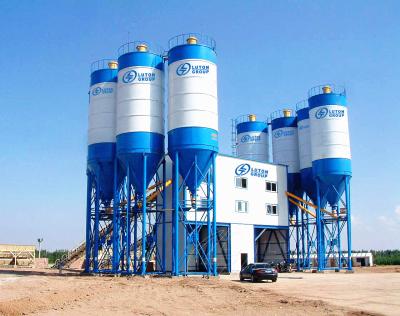
Mixing station: integrated aggregate silo, cement silo, metering system and mixing host, the single station production capacity can reach 200m³/h.
Pump truck: The arm length covers 21-72 meters, meeting the transportation needs of high-rise buildings.
Vibrating rod: High-frequency vibration (12,000-15,000 times/minute) eliminates bubbles inside the concrete.
Technology trend: The precast concrete component (PC component) production line realizes factory production through CNC marking machines, material placing machines and three-dimensional curing kilns, with component accuracy of ±1mm and production efficiency increased by 3 times.
2. Cement: The core of cementitious materials
Cement production involves the "two grindings and one burning" process, namely raw material grinding, clinker calcining and cement grinding.
Production process flow:
Raw material crushing and pre-homogenization: limestone, clay and other raw materials are processed by jaw crusher and homogenized by stacker.
Raw material preparation: ball mill grinds raw materials to a fineness of 80μm and the sieve residue is ≤10%, and the raw material homogenization warehouse ensures that the composition fluctuation is <±0.5%.
Clinker calcination: five-stage cyclone preheater and decomposition furnace realize raw material pre-decomposition, 1450℃ high temperature calcination of clinker in rotary kiln, and cooler recovers waste heat for power generation.
Cement grinding: the joint grinding system composed of roller press and ball mill grinds clinker to a specific surface area of 350-400m²/kg, and gypsum is added to adjust the setting time.
Key equipment:
Rotary kiln: diameter 4-6 meters, length 60-100 meters, daily clinker output 5000-10000 tons.
Vertical mill: grinding efficiency is 30% higher than ball mill, power consumption is reduced by 20%.
Packaging machine: fully automatic eight-mouth rotary packaging machine, output 120-180 tons per hour.
Environmental innovation: The new dry production line is equipped with SNCR denitrification system and electrostatic precipitator, nitrogen oxide emissions <100mg/m³, dust emissions <10mg/m³.
3. Aerated Bricks: Representative of Lightweight and Energy Saving
Aerated bricks are made of fly ash, cement and lime, and form a porous structure through chemical foaming, with a density of only 500-900kg/m³.
Production process:
Raw material processing: fly ash is refined by ball mill to 45μm sieve residue ≤20%, and quicklime is crushed and stored in a closed warehouse.
Batching and mixing: electronic scales accurately control the proportion of fly ash, cement, lime and aluminum powder paste, and the mixer mixes them into a uniform slurry.
Casting and foaming: the slurry is injected into the mold and stopped for 2-3 hours, and the aluminum powder reacts with alkali to release hydrogen to form pores.
Cutting and autoclaving: the flip cutting machine cuts the blank on six sides, and the autoclave is steam-cured at 180℃ and 1.2MPa for 8 hours.
Key equipment:
Autoclave: 2.85 meters in diameter and 30 meters in length, a single autoclave can accommodate 20m³ blanks.
Cutting unit: horizontal cutting accuracy ±0.5mm, vertical cutting accuracy ±1mm.
Packing line: Pallet-free wrapping packaging machine realizes automatic counting and bundling of finished products.
Performance advantages: aerated bricks have a thermal conductivity of 0.11-0.16W/(m·K), a sound insulation effect of 41 decibels, a fire resistance limit of 520 minutes, and are widely used in prefabricated building walls.
4. Technology integration and industrial upgrading
Modern construction raw material production presents three major trends:
Intelligent: DCS control system realizes real-time monitoring of production data, and AI algorithm optimizes ratio parameters.
Green: The annual processing capacity of cement kiln collaborative disposal of hazardous waste technology exceeds 20 million tons, and aerated bricks use fly ash and other industrial solid waste accounting for 70%.
Modularization: PC component production line realizes logistics automation through stackers and RGV trolleys, and the annual production capacity of a single line reaches 150,000 m³.
From efficient concrete pumping to low-carbon cement calcination, from precision cutting of aerated bricks to intelligent production of PC components, the construction raw materials industry is driving the industry towards high efficiency, environmental protection and intelligence through technological innovation. In the future, with the breakthrough of new technologies such as 3D printing concrete and nano-modified cement, building materials will open up a broader application space.