Categories
Tags
-
#thread rolling suppliers
#high speed thread rolling machine
#flat thread rolling machine
#thread rolling companies
#thread rolling equipment
#bolt former
#rolling machine china
#thread roller
#thread rolling machine manufacturer
#Multi-station bolt forming machine
#bolt rolling machine
#automatic bolt making machine
#bolt former machine
#cold head machine
Archives
Cold Forging vs. Machining for Bolts: Which is Better and Why
-
In today's highly competitive manufacturing landscape, choosing the right production method can significantly impact product quality, production speed, and cost efficiency. For bolt and nut manufacturing, cold forging and machining are two widely used methods. But which one is better for your production needs?
Let's dive into the key differences, advantages, and ideal use cases of cold forging versus machining so that you can make the most informed choice.
What Is Cold Forging?
Cold forging—also known as cold heading—is a metal forming process in which raw material (usually wire or rod) is shaped at room temperature using high-pressure dies and punches.
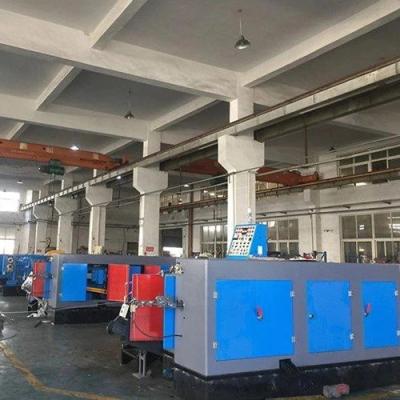
At Shengtuo Machine, we specialize in multi station cold forging machines such as 3-die 3-blow, 4-die 4-blow, 5-die 5-blow, and up to 7-die 7-blow configurations. These machines enable high-speed, multi-step forming of bolts ranging from M6 to M30 and lengths from 50mm to 355mm.
What Is Machining?
Machining is a subtractive manufacturing process that involves cutting, drilling, turning, or milling raw materials into desired shapes using CNC machines or lathes. This method is precise but usually slower and generates more material waste.
Cold Forging vs. Machining: Key Differences
Why Cold Forging Is the Superior Choice for Bolts
1. Higher Strength and Durability
Cold forging enhances the mechanical properties of bolts by aligning the grain flow with the part geometry. This results in parts with greater tensile strength, fatigue resistance, and impact tolerance compared to machined bolts.
2. Material Savings
Cold forging achieves near-net-shape production with minimal material waste. This is especially important in mass production scenarios where cost per piece must be optimized.
At Shengtuo Machine, our cold forging nut former machine is engineered to maximize material efficiency and reduce scrap generation across high-speed, multi-station operations.
3. Superior Production Efficiency
Multi-station forming machines—like the ones offered by Shengtuo—can produce complex parts such as hex head screws, flange bolts, or hollow fasteners in one automated cycle. Compared to machining, this drastically reduces cycle time and increases throughput.
4. Scalability for Industrial Applications
From automotive and aerospace to railway, wind power, and marine industries, cold forging is ideal for producing high-strength, high-volume parts with consistent quality.
5. Eco-Friendly and Cost-Effective
Cold forging consumes less energy than machining or hot forging and reduces environmental impact through lower waste and emissions. For manufacturers aiming for sustainable production, this process checks all the boxes.
Applications of Cold Forging
At Shengtuo Machine, our solutions are used to manufacture:
Inside/outside hexagon bolts
Flange screws
Hollow or solid fasteners
Non-standard shaped parts
As one of cold forming machine manufacturers, we also provide customized multi-station forming machines tailored to specific application needs—especially for customers requiring non-standard parts or specialty alloys like titanium, aluminum, copper, and stainless steel.
Certified Quality You Can Trust
Shengtuo Machine is ISO9001:2008 certified and our machines are CE certified, ensuring international-quality standards. Our equipment delivers precision, reliability, and long-term performance trusted by manufacturers worldwide.
While machining has its niche in custom, low-volume production, cold forging remains the gold standard for high-volume, high-strength bolt and nut manufacturing.
If you’re looking to boost your production efficiency, reduce costs, and improve part quality—cold forging is your answer.