Categories
Tags
Archives
When Overseas Factories Face the "Battery Production Capacity T
-
A Malaysian electric motorcycle factory was once caught in a vicious cycle: their expensively imported production line, while seemingly achieving "30 PPM efficiency," produced 12 welding defects per 1000 battery packs, resulting in a yield of only 98.8% and equivalent annual losses exceeding one million dollars. As a global-focused prismatic cell equipment exporter, Shenzhen CYGROUP Intelligent Equipment Group employs a "parameter visualization + process closed-loop" solution to help overseas clients transform the "theoretical values" on equipment datasheets into tangible "actual capacity" on the workshop floor.
From "Debugging Upon Arrival" to "Production Out-of-the-Box": The Localization Code for Exported Equipment
For overseas clients, the biggest headache is often not the equipment itself, but the "implementation gap" across thousands of miles. CYGROUP Intelligent's standard production line (80000×1000×3500 mm) eliminates localization barriers through three key designs:-
Dual Voltage & Safety Certification: Supports 110V/220V/380V self-adaptive power grids and carries UL/CE/SGS triple certification. A client in Brazil completed power system integration in just 48 hours, 60% faster than the industry average.
-
Multilingual Smart Interaction System: The HMI interface supports 8 languages (English, Spanish, Arabic, etc.) and includes a "fault code-solution" database. Technicians at an Indian factory can access localized maintenance videos simply by scanning a code.
-
Climate Adaptation Modifications: Equipped with anti-condensation AC systems and corrosion-resistant conveyor belts for Southeast Asia's hot and humid environments. An energy storage project in Thailand maintained 98.3% equipment utilization even during the rainy season.
This "global standard + local adaptation" model compresses the cycle from port arrival to production commencement to 15 days, significantly faster than the industry average of 45 days.
The "Moisture Test" of 30 PPM Efficiency: Why Do Most Lines Fail to Achieve Design Capacity?
Clients are often drawn to the "30 PPM" parameter but overlook the efficiency logic behind the 150 kW power consumption and ±0.2mm repeatable accuracy. CYGROUP uses a "Three-Question Test" to reveal the true performance:-
Sustained Operation Capability: In a stress test at a Mexican factory, the line maintained a stable output of 28 PPM for 72 hours continuously, with a single-unit failure rate of only 0.3%, equivalent to less than 24 hours of unplanned downtime per year.
-
Changeover Speed Verification: Switching from producing electric golf cart batteries to communication base station storage batteries required replacing only 3 fixture sets and scanning to load the process package, taking 18 minutes – a 567% improvement over the industry average of 2 hours.
-
Energy Conversion Rate: An energy recovery system for servo motors feeds braking energy back to the grid. Measurements at a Spanish factory showed a 22% reduction in energy consumption per unit product compared to similar lines, saving over €120,000 annually in electricity costs.
Meeting these "dynamic parameters" is the real foundation for achieving >98% utilization – not peak speed in short bursts, but stable output day after day.
The Process Closed Loop for 99.9% Yield: 14 "Quality Locks" from Cell to Pack
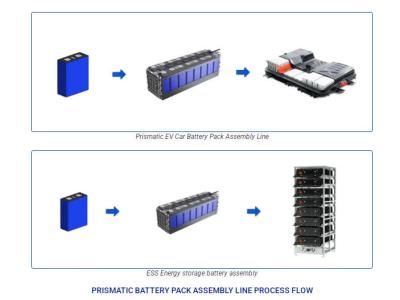
The transformation of a Philippine electric boat battery project is highly persuasive: Before introducing CYGROUP's intelligent production line, manual welding caused a 15% rate of faulty busbar connections. After the upgrade, a fully automated 14-step process achieved a quality leap:-
OCV Testing + AI Sorting: Cells with voltage deviations >5mV are rejected at the loading stage, achieving an initial yield rate of 99.7%.
-
Dual-Assurance Laser Welding: Uses galvanometer scanning + pressure feedback technology for real-time weld strength monitoring, achieving a 100% defect detection rate.
-
Dual EOL Testing: Both modules and full packs undergo 12 electrical performance tests, including high-low temperature cycle testing from -40°C to 85°C.
Post-upgrade, the line's yield rate jumped to 99.92%, meaning only 8 defective products per 10,000 packs produced, recovering over $3 million in annual losses and shortening the investment payback period to 11 months.
As more overseas factories realize that "buying equipment ≠ buying capacity," competition among lithium-ion prismatic cell equipment exporters has moved beyond parameter comparisons to the stage of "full-lifecycle value delivery." From high-safety batteries for electric firefighting robots to long-life cells for satellite power systems, CYGROUP's decade of overseas service experience proves that stable yield rates, flexible compatibility, and rapid local response are the three keys to breaking the "production capacity trap."
(Click https://auto-odm.com/ to get the Overseas Battery Factory Commissioning Checklist, including power standard comparison tables for 12 countries and key line acceptance metrics.)
-