Categories
Tags
Archives
Key Factors in Achieving Certification.
-
From Sunshading to Security: How Aluminum Shutters & Roller Shutters Redefine the Building Envelope
When discussing building energy efficiency and residential safety, a critical element often overlooked is silently at work in 90% of European buildings – the Aluminum Shutter & Roll Shutter. While seemingly similar, these two products, through ingenious structural design, become the "building's intelligent skin," balancing daylight, privacy, energy saving, and security. Domestically, driven by the "Dual Carbon" policy and upgraded demand for high-end residences, they are transitioning from "niche choices" to "standard features of quality," particularly demonstrating comprehensive advantages unmatched by traditional window coverings in noise-polluted cities and regions with extreme climates.
Tech Decoded: Core Differences Between Aluminum Shutters & Roller Shutters
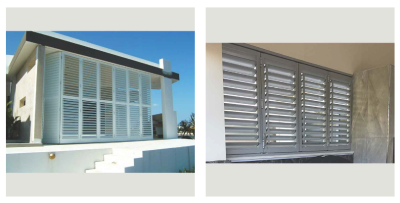
Many homeowners often confuse these two products, yet their technical positioning is distinctly different. The Aluminum Shutter is a rigid shading system made from 6060/6063-T5 aluminum alloy base material, forming hollow slats (filled with polyurethane foam) via roll forming. Its core characteristic is adjustable slat angles (0°-135° stepless adjustment), enabling both 100% blackout (slats interlock forming a sealed surface when fully closed via "V-shaped slat" design) and private ventilation with "light without shadow" through 25mm standard spacing. The Roller Shutter, conversely, employs an integrated lath structure (typically double-layer aluminum alloy sandwich panels), raised and lowered via a rolling mechanism, focusing more on complete protection – when closed, it forms a physical barrier comparable to security grilles, with impact resistance strength exceeding 1500 N/m².From a technical parameter perspective, high-quality Aluminum Shutters should have slat thickness ≥1.2mm, with surface treatment reaching PVDF coating or anodizing (salt spray test ≥5000 hours) to withstand harsh outdoor environments. For Roller Shutters, a key indicator is drive system stability; electric models should include obstacle detection/auto-reverse (sensitivity ≤50N) and emergency manual operation, ensuring functionality during power outages. Field data from a coastal project showed that after installing 6061-T6 Aluminum Shutters, the sound insulation performance of the building's external windows improved from 30dB to 42dB, summer indoor temperature decreased by 4-6°C, and cooling load reduced by 32%.
Scenario-Based Solutions: Technical Adaptation from Villas to High-Rises
Different building types have significantly varying needs for shutter systems; blind selection leads to either "function waste" or "performance shortfall."-
Independent Villas: Aluminum Shutters are recommended. Their wood grain print surface treatment blends naturally with the building facade, while the "3° forward-tilt slat" design reduces air resistance, improving ventilation efficiency by 18% compared to traditional vertical slats.
-
Street-Facing High-Rise Apartments: Prioritize the security and sound insulation of Roller Shutters. Use reinforced guides (depth ≥80mm) and anti-lift locks, paired with 1.5mm thick double-layer aluminum alloy laths, capable of resisting 12-grade typhoon wind pressure and reducing ambient noise by 18dB.
-
Commercial Buildings (e.g., glass curtain wall offices): The "smart linkage" function of electric Aluminum Shutters is particularly important – automatically adjusting slat angles via light sensors; closing automatically when light intensity >60,000 lux, improving energy saving rate by 22% compared to traditional shading systems.
Installation details directly determine user experience. For instance, installing Aluminum Shutters requires guide rail vertical deviation ≤1.5mm/m, otherwise slat jamming or noise may occur. Fixing the roller tube for Roller Shutters must use "expansion anchors + pre-embedded steel components" to prevent wall cracking from long-term load bearing. The 22,800 m² shading project at Nantong Golden Home community confirmed the value of professional installation – using custom coffee-colored laths matching the building's exterior color scheme, it achieved 80% shading rate while becoming a signature aesthetic element for the development.
The Underestimated 'Hidden Value': Recalculating Lifecycle Cost
Most owners focus only on initial investment, overlooking the long-term economics of Aluminum Shutter & Roller Shutter. Taking a 100 m² residence as an example:-
Ordinary fabric curtains incur an average annual replacement cost of about ¥800, totaling ¥16,000 over 20 years.
-
The initial investment for Aluminum Shutters is about ¥12,000, but with zero maintenance cost (no cleaning or replacement needed), and significant energy savings – reducing winter heating costs by 30% and summer AC electricity bills by 25%. Calculating based on an annual energy expenditure of ¥3,000 in Beijing, the price difference can be recouped in 5-6 years.
-
More noteworthy is their property value enhancement effect. Data from a Shanghai high-end residential project shows units equipped with Aluminum Shutters had a 15% shorter transaction cycle and a premium rate of 7%-9%.
Regarding sustainability, the 100% recyclability of Aluminum Shutter & Roller Shutter makes them a plus for green building certification. Compared to wood or PVC products, their production process reduces carbon emissions by 62%, and during the use phase, they can reduce the building's carbon footprint by about 18 kg/m²/year. Practice in a LEED Platinum certified project showed that the external shading shutter system contributed 12% of the weight in the energy saving credit category, becoming a key factor in achieving certification.
Purchasing Guide: Avoiding Pitfalls & Key Control Points from Specs to Installation
With varying product quality on the market, owners need to focus on three core indicators:-
Slat/Lath Structure: High-quality Aluminum Shutters should have seamless welded hollow slats, filled with polyurethane density ≥40 kg/m³ (ensuring thermal and acoustic insulation). For Roller Shutters, check the "anti-dislodgement hook" design at lath connections to prevent misalignment after long-term use.
-
Control System: Electric models must be equipped with overload protection motors (power ≥60W) and backup batteries (ensuring 3-5 operations after power failure).
-
Installation Workmanship: The gap between guides and the wall must be filled with fire-resistant rock wool, sealed externally with weatherproof sealant, preventing moisture penetration and wall mold.
Comparative tests by a third-party inspection agency showed that substandard products failing the above criteria exhibited slat deformation of 3.2mm (far exceeding the national standard limit of 1.5mm) and a 40% degradation in sound insulation performance after -20°C to 60°C thermal cycling. Therefore, choosing brands offering warranties of 5 years or more (covering motor and structure) is crucial, directly reflecting the manufacturer's confidence in product durability.
From a century of European experience to practices in new domestic high-end projects, Aluminum Shutter & Roller Shutter have transcended their traditional role as "shading window coverings" to become "active regulation systems" for building performance. Their value lies not only in enhancing living comfort but also in redefining the "sense of security" and "sustainability" of modern homes through energy saving and consumption reduction (reducing carbon emissions by about 2.3 tons/household over their lifecycle) and safety protection (reducing break-in risk by 70%). For quality-seeking owners, choosing a shutter system suited to the scenario is essentially a rational investment in the building's long-term value – after all, truly comfortable living always resides within those unseen technical details.
Interested in learning how to customize the optimal solution based on your layout, orientation, and budget? Professional selection tools can help you calculate energy savings and investment payback periods, transforming every bit of investment into tangible improvements in your living experience.
-