Categories
Tags
Archives
Choosing the optimal Airtrack for home training
-
Which Airtrack should I choose?
For many people, it can be confusing to know which Airtrack is right for your family or children. And it can also be a bit of a jungle to navigate the many different models and sizes. There are many things to consider when choosing the right Airtrack for your child's needs. Below you'll find advice and guidance on making the right decision so you get the most out of your new Airtrack.Read more about how you can use an Airtrack for home training
Choose the right height for your Airtrack
It's important to consider the size of your gymnast when choosing an appropriate Airtrack. Quite logically, smaller gymnasts and children will benefit from a smaller Airtrack, while larger gymnasts will need a larger Airtrack. It is especially the height of the Airtrack that you should consider, as this has an impact on the rebound. Generally speaking, the higher the Airtrack, the more you can adjust the height and the more height you can get on your jumps, and typically this will also make using the Airtrack even more fun.An Airtrack with a height of 10 cm is suitable for smaller children and beginners. When children reach their teenage years and become heavier, they will need a higher Airtrack, otherwise it will have to be pumped up relatively hard so that they do not feel the ground through the Airtrack. Conversely, if you are used to jumping on sprung or rhythmic floors, a hard Airtrack will give you the opportunity to practise your jumps on a similar surface. An Airtrack with a height of 10 cm is therefore best suited for children and gymnasts under 12-13 years or gymnasts who are used to jumping on a harder surface. It is also ideal for jumping and playing indoors in rooms with normal ceiling heights. A problem that can sometimes arise when jumping indoors.
Taller gymnasts will therefore benefit most from an Airtrack with a height of 15 cm, as they can adjust the air pressure to suit their needs. An Airtrack of 15 cm allows for good adjustment of the hardness and makes it possible to get higher in the air.
An Airtrack with a height of 10 cm is suitable for:
" Smaller children and gymnasts
" Games and jumps at beginner level
An Airtrack with a height of 15 cm is suitable for:
" Advanced gymnasts and older children
" High level jumping
All things that are super fun to try if you are into tumbling or gymnastics.
Read more about why Airtracks are so great
How People of Different Ages Use an AirTrack
AirTracks, inflatable mats designed for gymnastics, tumbling, and various fitness activities, have become increasingly popular across different age groups. Their versatility, safety, and ease of use make them suitable for a wide range of activities tailored to varying skill levels and fitness goals. Whether you're a child just starting gymnastics, a teenager refining your skills, an adult looking for a fun way to stay fit, or a senior seeking a low-impact exercise option, an AirTrack can be a valuable addition to your routine. Here’s how people at different ages use an AirTrack:
Children (Ages 5-12)
For children, an AirTrack provides a safe and fun environment to explore basic gymnastics, balance, and coordination skills. Younger children often use an AirTrack to practice simple exercises such as forward rolls, cartwheels, and jumps. The soft, cushioned surface reduces the risk of injury, allowing them to gain confidence as they learn new movements. The mat’s bouncy nature also adds an element of play, turning fitness into an enjoyable activity.
Parents and coaches often use AirTracks in structured gymnastics or physical education classes to teach foundational skills. The adjustable air pressure allows for customization to suit the child’s weight and skill level, making it a versatile tool for progressive learning. Additionally, children can use the AirTrack for creative play, building obstacle courses, or even as a safe surface for dance and cheerleading practice.
Teenagers (Ages 13-19)
Teenagers often use AirTracks for more advanced gymnastics and cheerleading routines. As they develop their strength, flexibility, and coordination, teens use the AirTrack to practice flips, handsprings, and aerials with added bounce and less impact on their joints. The mat’s durability and cushioning help prevent injuries from repetitive training, making it a popular choice for home use and in gyms.
Beyond gymnastics, teenagers may also use the AirTrack for strength training exercises like push-ups, sit-ups, and plank variations, incorporating the mat’s slight instability to engage core muscles more effectively. Dance enthusiasts can use the mat to practice jumps and leaps, while parkour and tricking practitioners enjoy the extra height and safety it provides for their acrobatic moves.
Adults (Ages 20-50)
Adults use AirTracks for a variety of fitness and recreational activities. For those interested in maintaining or improving their fitness levels, an AirTrack offers a unique way to perform low-impact exercises that are gentle on the joints but still provide an effective workout. Pilates, yoga, and general aerobics can all be adapted to the AirTrack’s soft, responsive surface, adding an element of balance training that engages stabilizing muscles.
Gymnasts and cheerleaders who have continued their practice into adulthood appreciate the AirTrack for its ability to provide a safe surface to refine their skills or learn new tricks without the high impact of traditional gym floors. Meanwhile, fitness enthusiasts can use the AirTrack for cardio workouts, plyometric exercises, and core strengthening routines that utilize the mat’s bounce for added intensity.
Seniors (Ages 60 and above)
For seniors, an AirTrack can offer a safe, low-impact platform for maintaining mobility, flexibility, and strength. Older adults can use the AirTrack to perform gentle stretching, balance exercises, and light aerobic activities. The cushioning effect reduces the impact on joints, making it an ideal choice for those with arthritis or other joint concerns. Simple exercises like seated stretches, standing balance work, or even light yoga can be performed with greater comfort and reduced risk of injury.
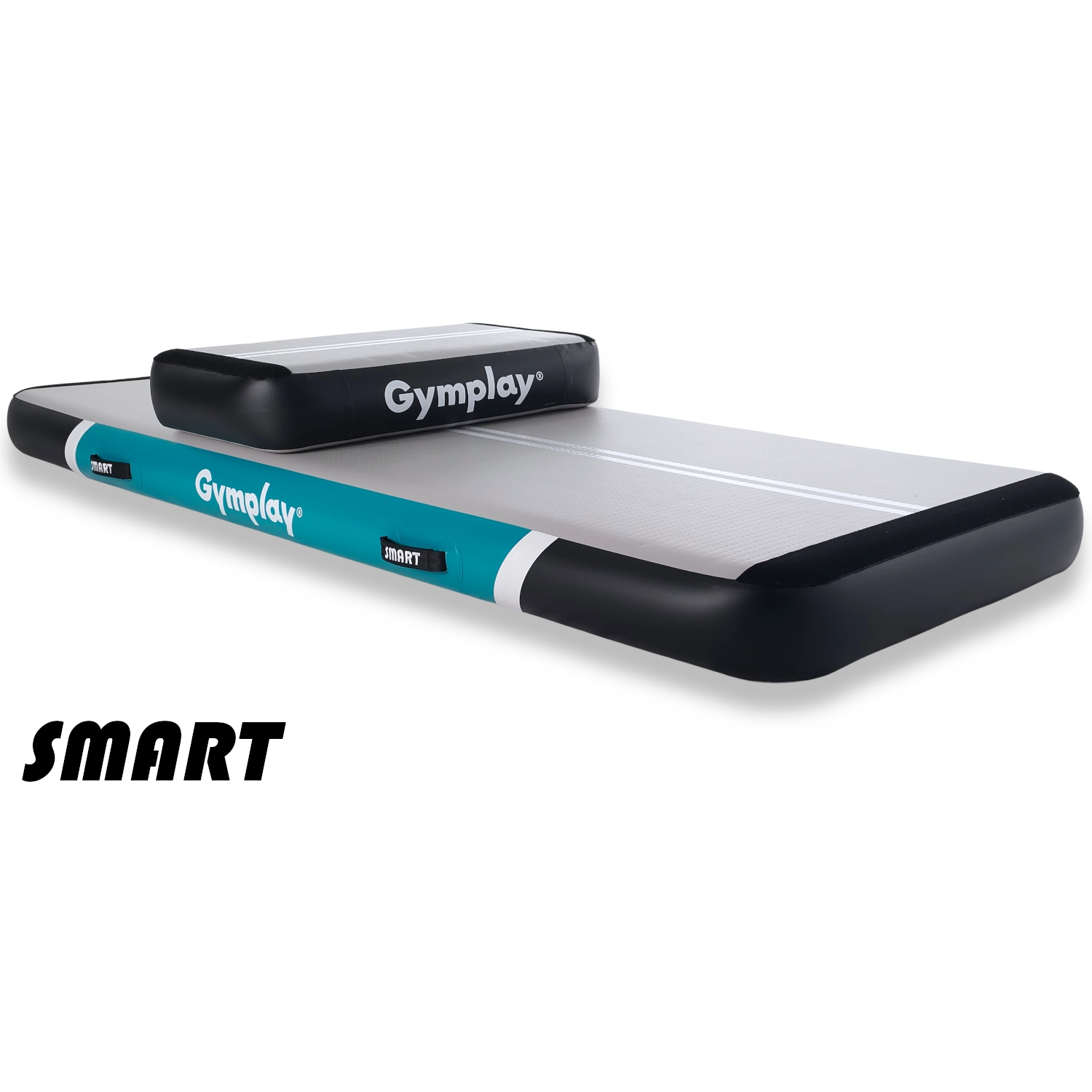
H10 Airtrack - for smaller children and beginners
H15 Airtrack - perfect for advanced gymnasts
3 x h15 airtrack
Choose the right Airtrack length
Once you have chosen the height of your Airtrack, you need to decide how long it should be. In doing so, you need to take into account the gymnast's level and needs, among other things. If the Airtrack is used to train single jumps, such as the weathermill, the roll or the power jump, you can easily make do with an Airtrack of 3 metres. If you want to be able to do wilder, compound jumps, such as the Arabian-flip, or Arabian-flip-stretch, you need more length. Therefore, the level of the gymnast has a great influence on the length of the Airtrack.Of course, you also need to take the gymnast's size into account. A small gymnast of 140 cm can do araber-flik on a 3 meter track, while a bigger gymnast needs a total jump track of at least 4-5 meters or more to be able to do this. Keep in mind that an Airtrack can always be built longer with more Airtracks, springboards, landing mats or an incline. An easy and quick way to extend your jumping track and get even more out of your Airtrack.
3-4 meter long Airtrack:
" Small gymnasts can put together two jumps such as the Arabian-flip
" Bigger gymnasts can do single jumps like power jump, flap, weather vane
" Good for active play and strengthening motor skills
5-6 meter long Airtrack:
" Suitable for jumping series consisting of 2-4 jumps depending on the size of the swing arm
" Advanced gymnasts can speed up and make complicated jumps
" Best suited for outdoor use
7+ meter Airtrack:
" Perfect for advanced gymnasts who want to do longer jumps or complicated jumps
" Good possibility for long run-up, which gives more speed and higher jumps
"Suitable for outdoor use or gymnasiums
This was a bit about the various sizes of Airtracks, something that is very important when you try to decide on which Air track to buy.
Read more about the advantages of using an Airtrack
Think practical in your choice of Airtrack
It may be tempting to buy the biggest Airtrack possible. But it's worth noting that size often compromises where you can use your Airtrack and how easy it is to handle. A large Airtrack will often be a tool used outdoors during the summer months, while a smaller Airtrack can be used both indoors and outdoors throughout the year.Weight and handling are also worth taking into account
A 15 metre Airtrack Pro weighs around 100kg and it takes several people to unpack and pack it. A 3 meter H10 Airtrack weighs about 10 kg and can easily be handled by one person. Therefore, if you want to have a total jumping area of, for example, 6 metres, it may also be appropriate to consider whether, instead of choosing one 6-metre Airtrack, you should choose two 3-metre Airtracks. This makes handling easier and is practical if you want to be able to use it both indoors and outdoors.
This was a little bit about choosing the optimal Airtrack for home training and which things you should consider before even buying one.