Categories
Tags
-
#concrete
#asphaltplant
#Self Loading Concrete Mixer
#Concrete Batching Plant
#concrete pump
#trailer concrete pump
#Jaw Crusher
#Mobile Concrete Batching Plant
#Asphalt Mixing Plant
#concrete plant
#Crushing Plant
#crushing equipment
#crusher machines
#cone crusher
#stationary crushing plant
#Brick Making Machine
#self loader concrete mixer
#DUMP TRUCK
#Concrete Equipment
#mobile crushing plant
#Construction Equipment
#concrete pumping machinery
#concrete production
#construction machinery
#concrete mixing plant
#concrete boom pump
#selfloadingconcretemixer
#doubledrumasphaltmixingplant
#asphalt concrete
#asphalt batching plant
#concretebatchingplant
#operator of concrete mixing plant
#Aggregate Concrete Mixing Plant
#Hzs90 concrete mixer plant
#concrete pump truck
#automatic control
#concretemixerpump
#controlunit
#Belt-Type 90m³/H HZS90 Station
#concreteplant
#concretemixingplant
#concretemachinery
#concretebatchingmachinery
#Construction Materials
#crushing machine
#electric control
#dust removal equipment
#asphaltbatchingplant
#cold asphalt plant
#concrete mixing plants
#concrete plants
#control system of concrete batching plant
#mortar
#brickes
#crushingequipment
#stonecrusher
#constructioncrushingequipment
#mobile crushing equipment
#crushing machinery
#concrete pumping equipment
#concrete batching plants
#weighing methods of concrete plant
#automatic concrete batching plant
#concrete pumping control system
Archives
The Evolution of the Core 'Brain'
-
Posted by Mavis Chai Filed in Technology #concrete pumping equipment #concrete pumping control system 31 views
In modern engineering construction, concrete mixing pumps are like efficient "delivery hearts", and the control system behind them is the "core brain" that drives this heart and ensures its precise operation.
The composition and performance of current mainstream control systems
Nowadays, high-performance concrete pump control systems on the market have formed a precise system that integrates perception, decision-making, and execution.
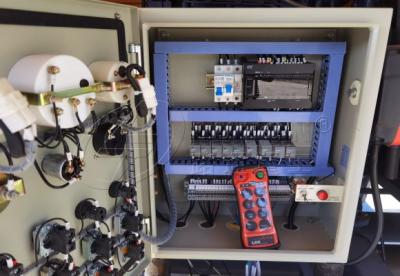
1. Core Hardware Configuration: Mainstream systems typically adopt an architecture of "Industrial Computer (IPC)+Programmable Logic Controller (PLC)+Sensor Network". As the cornerstone of on-site control, PLC directly manages all underlying actions such as pumping, mixing, and reversing, ensuring stability and reliability; The upper level industrial control computer provides a human-computer interaction interface for formula management, data monitoring, and complex calculations.
2. Core Control Logic: The fundamental task of the system is to coordinate two core actions:pumping and distribution. Whether it is traditional electrically controlled directional control (PLC controlled solenoid valve) or more stable fully hydraulic directional control technology, their goal is to precisely control the reciprocating motion of the main oil cylinder and the switching rhythm of the S-tube (or skirt valve). Advanced systems will monitor parameters such as pressure and oil temperature in real-time through sensors, achieving functions such as automatic pump reversal and fault warning.
3. Key Performance Performance:
Efficiency: By optimizing the reversing logic and pump displacement control, the equipment's discharge volume is maximized.
Stability: System reliability directly affects construction continuity. High protection level components and anti-interference design are the basic guarantees.
Operability: From traditional multi handle complex operations, it is gradually evolving into intelligent remote control with auxiliary functions such as one click leveling and arm end following.
The advantages and bottlenecks of existing technology
The current mature control system has obvious advantages, but it also faces new challenges.
Main advantages:
Mature technology and high reliability: The control scheme with PLC as the core has been validated in the market for a long time and is stable and durable in most conventional construction scenarios.
Fully functional and adaptable: Equipped with multiple functions such as manual/automatic switching, reverse pump dredging, pressure regulation, etc., it can meet a wide range of needs from civil construction to infrastructure.
Convenient maintenance: Modular design and relatively standardized electrical components reduce the technical threshold and cost of later maintenance.
Highlight bottleneck:
Highly dependent on operator experience: The pumping efficiency and handling of sudden pipe blockages still largely depend on the operator's experience and on-site judgment, and the level of intelligence is insufficient.
There is a "perception" blind spot: the system has limited active perception ability of its own state (such as wear of key components) and external environment (such as changes in pumping resistance, distance between the arm and obstacles), and poor prevention.
Information island: Single machine equipment is difficult to link data with other construction processes such as mixing plants and transport vehicles, making it impossible to achieve optimal global efficiency.
Energy consumption and impact: The traditional commutation process can cause flow and pressure pulsations, resulting in periodic impacts that not only consume energy but also affect the lifespan of structural components.
For more details on concrete pumping equipment, please visit lutonmachinery.com.
Future technological development: towards intelligence and collaboration
The future pumping control system will go beyond the scope of single machine control and evolve towards a more intelligent, green, and collaborative direction.
1. Deep intelligence and active perception: The future 'brain' will have stronger learning and decision-making abilities. By integrating high-precision sensors and AI algorithms, the system can analyze the pumping pressure curve in real time, actively predict and avoid the risk of pipe blockage, rather than just passively handling it after blockage. Meanwhile, based on digital twin technology, device operation can be mapped and optimized in the virtual world to achieve predictive maintenance.
2. Full electric drive and precise control: The wave of electrification is irreversible. The direct drive of the motor not only brings zero emissions and low noise, but more importantly, achieves instantaneous and precise control of power output. This will lay the foundation for completely eliminating directional shock and achieving true continuous constant flow and smooth pumping, thereby greatly improving construction quality and equipment lifespan.
3. Cluster collaboration and unmanned construction: The boundary of the control system will be extended from a single machine to the entire "cluster". Through the Internet of Things and 5G technology, pump trucks will be connected in real-time with equipment such as mixing plants, transport vehicles, and tower cranes. Under the unified intelligent construction platform scheduling, various devices can work together like "robots dancing in harmony", independently completing the entire process from material proportioning, transportation scheduling to precise fabric distribution, and ultimately achieving safe and efficient unmanned construction in specific scenarios.
In summary, the concrete pumping control system is evolving from a functionally stable "automatic machine" to a "smart system" with perception, decision-making, and learning capabilities. This digital and intelligent driven transformation will ultimately liberate construction workers from dangerous, heavy, and experience dependent work, and move towards a safer, more efficient, and greener future of construction.